


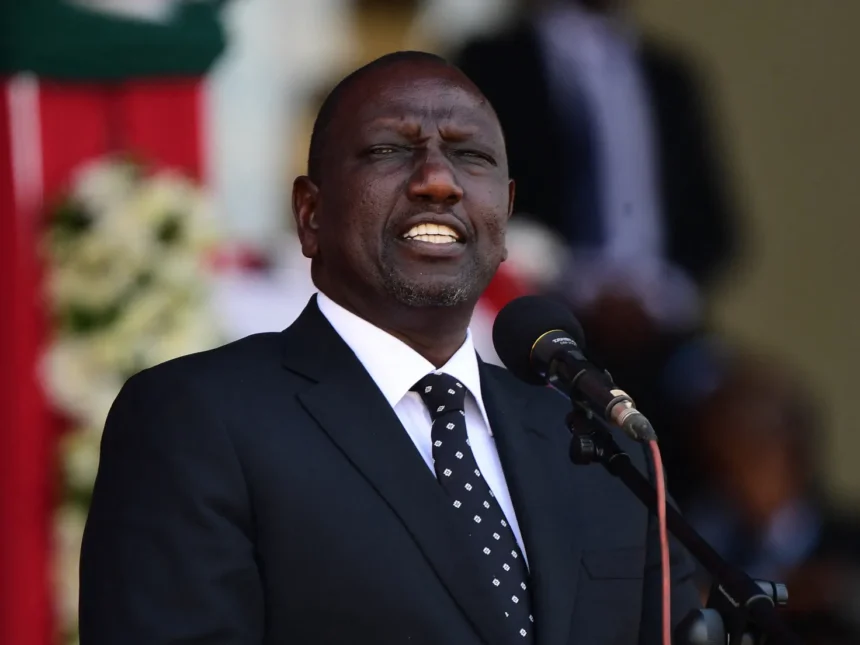
NAIROBI, Kenya — Kenyan President William Ruto has ordered authorities to take action against foreign nationals operating small-scale businesses and engaging in hawking, saying such businesses should primarily be reserved for Kenyan citizens.

Speaking to micro, small and medium-sized enterprise traders at State House in Nairobi, Ruto directed the relevant authorities to begin enforcement against foreigners involved in small-scale retail and hawking from September 7.
The President argued that foreign investors remain welcome in Kenya, particularly in businesses requiring significant capital, but questioned why foreigners should compete with ordinary Kenyans in small businesses requiring limited investment.
The directive has sparked debate across the region, with concerns emerging over whether Kenya could be witnessing a shift towards policies similar to those seen in parts of Southern Africa, where foreign nationals operating informal businesses have faced growing public and political pressure.
The development comes against the backdrop of heightened regional tensions following the June 2026 denial of entry into Uganda of renowned Kenyan lawyer and opposition leader Martha Karua.
Karua had travelled to Uganda to participate in legal proceedings involving opposition politician Dr Kizza Besigye and his co-accused. However, she was denied entry at Entebbe International Airport and ordered to return to Kenya. Ugandan authorities subsequently described her as a prohibited immigrant/persona non grata.
Karua later challenged the decision in Uganda’s courts, arguing that her exclusion interfered with her ability to participate in the defence of her clients.
Her treatment, alongside reported restrictions involving her movements in Tanzania, has contributed to wider conversations about the treatment of East Africans across the region and the principle of free movement within the East African Community.
However, there is no confirmed evidence that Ruto’s directive was issued specifically because of the Karua incident. The Kenyan government has instead presented the policy as an economic measure intended to protect Kenyan small-scale traders from competition.
Kenya’s Foreign Affairs Principal Secretary Korir Sing’oei has also sought to clarify the government’s position, saying foreign nationals with the required work permits, licences and documentation remain legally protected to conduct business in Kenya.
The developments have nevertheless raised questions among foreign traders and small-business operators in Kenya, particularly those from other African countries, about what the new enforcement measures could mean for their livelihoods.
As East African countries continue to pursue regional integration and cross-border trade, the growing restrictions and diplomatic disputes involving foreign nationals could put the region’s commitment to free movement and economic integration under renewed scrutiny.