

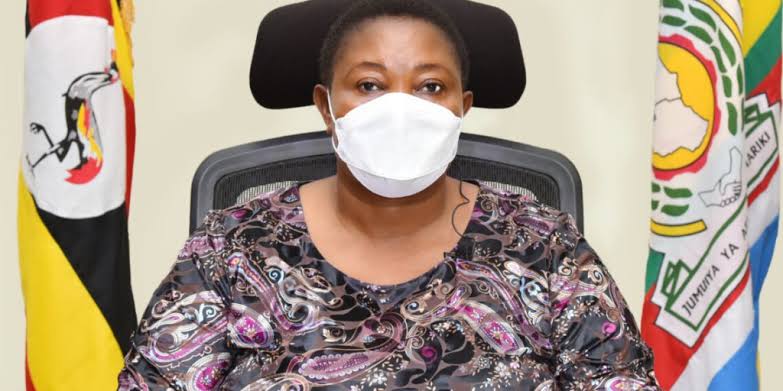
Minister for the Presidency Milly Babalanda has called for a constitutionally guided approach to Uganda’s political succession debate, warning against developments that could deepen divisions within the ruling National Resistance Movement (NRM) and its wider political circles.
In an opinion article addressing the increasingly prominent discussion about leadership beyond President Yoweri Museveni, Babalanda said political ambitions should be pursued within the law, while the country’s current leadership continues executing its mandate.
She stressed that Uganda’s leadership transition must be determined through established constitutional and electoral procedures rather than political pressure or premature contests for influence.
Citing Article 105(1) of the Constitution, which stipulates a five-year presidential term, Babalanda maintained that Museveni remains the duly elected President and that public officials have a responsibility to implement his lawful directives.
“I have no fundamental objection to Ugandans discussing future leadership or preparing for a political transition through lawful means,” she wrote, adding that leadership tenures are ultimately governed by the Constitution and the passage of time.
Succession Debate Raises Questions Within NRM Circles

Babalanda’s intervention comes against the backdrop of concerns raised by Older Persons Representative for Eastern Uganda Ofwono Opondo and presidential adviser Proscovia Nalweyiso regarding the timing and possible implications of succession campaigns.
Opondo cautioned that efforts to promote a post-Museveni presidency could be interpreted as a lack of confidence in the incumbent, potentially generating uncertainty and affecting investor perceptions.
Nalweyiso, meanwhile, questioned the rationale for intensifying succession discussions after Museveni began a new term, urging political actors to prioritise the implementation of the NRM manifesto for 2026–2031.
The differing interventions reflect an ongoing debate within the ruling political establishment over how to balance discussions about future leadership with the administration’s current priorities.
Minister Clarifies Position on Muhoozi
Babalanda also responded to criticism arising from her directive to resident district commissioners (RDCs) to remain loyal to the President and carry out their official responsibilities.
According to her account, some supporters of the Patriotic League of Uganda (PLU) interpreted the directive as opposition to Chief of Defence Forces Gen Muhoozi Kainerugaba, who is associated with the organisation.
She rejected that interpretation, describing Kainerugaba as her brother and commending his contribution to national security and the fight against corruption.
Her clarification sought to distinguish support for Museveni’s current administration from opposition to discussions about future leadership, arguing that the two positions are not inherently incompatible when pursued within the law.
Appeal for Restraint and Political Tolerance
The minister further urged supporters of the NRM and PLU to exercise restraint, warning against insults, intimidation and personal attacks in discussions about the country’s political future.
She called on political actors to focus on policies, ideas and programmes while allowing room for differing opinions.
Babalanda argued that succession discussions should not become a source of hostility or undermine relationships within the broader political establishment.
Her intervention adds to a growing conversation about constitutional governance, party cohesion and the future of Uganda’s political leadership, with calls for lawful processes and political restraint featuring prominently in the debate.